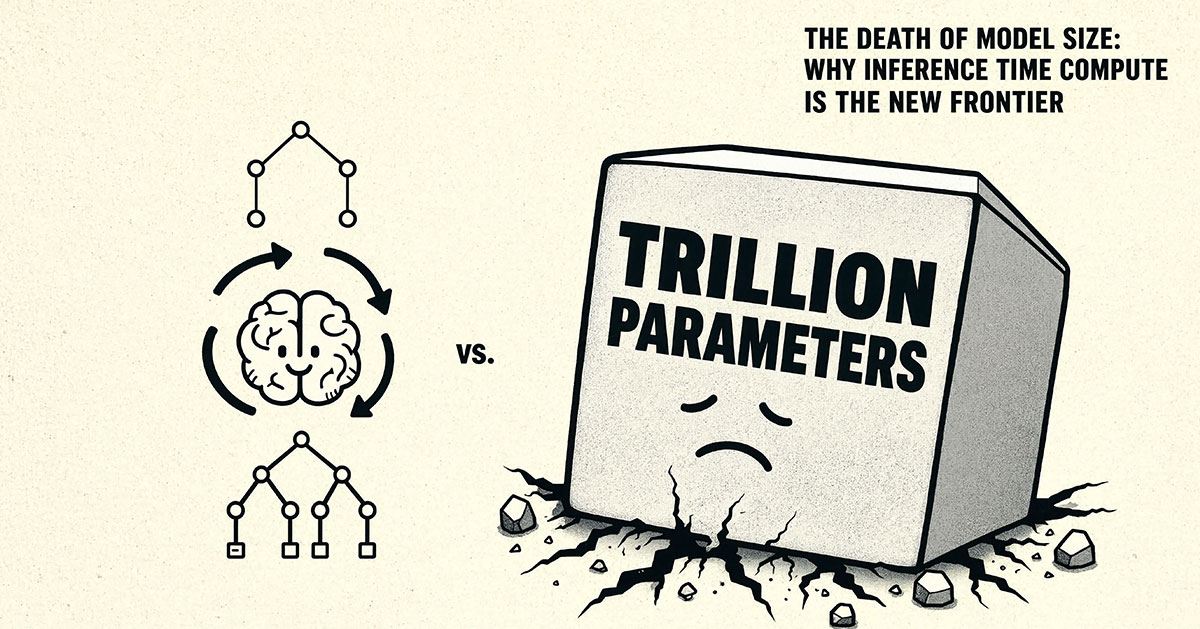
For years, the AI industry operated on a simple, almost primitive belief. If you wanted a smarter model, you added more parameters. We raced toward 100B, 500B, and trillion parameter behemoths, believing that scale was the only path to intelligence. But mid 2026 has arrived, and the playbook has fundamentally changed.
The Great Parameter Lie
We are witnessing the end of the era where model size was the primary proxy for capability. The industry is discovering that a 3B parameter model, if given the right architectural support and enough time to think, can consistently outperform a 70B model that is forced to answer instantly. The secret is not in how many neurons the model has, but in how much compute is allocated to a single query.
Enter Inference Time Compute
Inference time compute refers to the processing power used after the model has been trained, specifically during the act of generating a response. Instead of a straight line from input to output, we are seeing the rise of agentic loops and reasoning chains.
Think of it as the difference between a snap judgment and a thoughtful deliberation. A massive model performing a single forward pass is like a genius answering a question without thinking. A smaller model using a reasoning loop is like a diligent student with a scratchpad, checking their work and correcting errors before delivering the final answer.
The Four Pillars of the New Era
The shift is being driven by four key engineering breakthroughs:
- Chain of Thought (CoT): Forcing the model to decompose complex problems into smaller, sequential steps.
- Self Correction Loops: Allowing the model to critique its own first draft and iterate until the logic holds.
- Search-Based Decoding: Exploring multiple potential paths of reasoning and selecting the one with the highest confidence.
- Harness Engineering: Building the software infrastructure that manages these loops, ensuring the model does not spiral into infinite recursion.
Why This Matters for the Real World
The implications are staggering. First, the cost of intelligence is plummeting. Running a 3B model is orders of magnitude cheaper and faster than running a 70B model. When that smaller model can match the quality of the larger one through smart loops, the economic barrier to entry for AI agents vanishes.
Second, we are seeing a move toward specialization. We no longer need one giant model that knows everything. We need a fleet of small, hyper efficient models that know how to reason through specific domains. This is the birth of the true agentic economy.
The Future: Compute as a Variable
In the near future, you will not choose a model based on its size. You will choose a compute budget. For a simple summary, you might allocate 100 tokens of reasoning. For a complex architectural design or a legal analysis, you might allocate 10,000 tokens of inference compute. Intelligence is becoming a sliding scale, controlled by the user and the budget, not just the weights of the file.
The race for the biggest model is over. The race for the most efficient reasoner has begun.