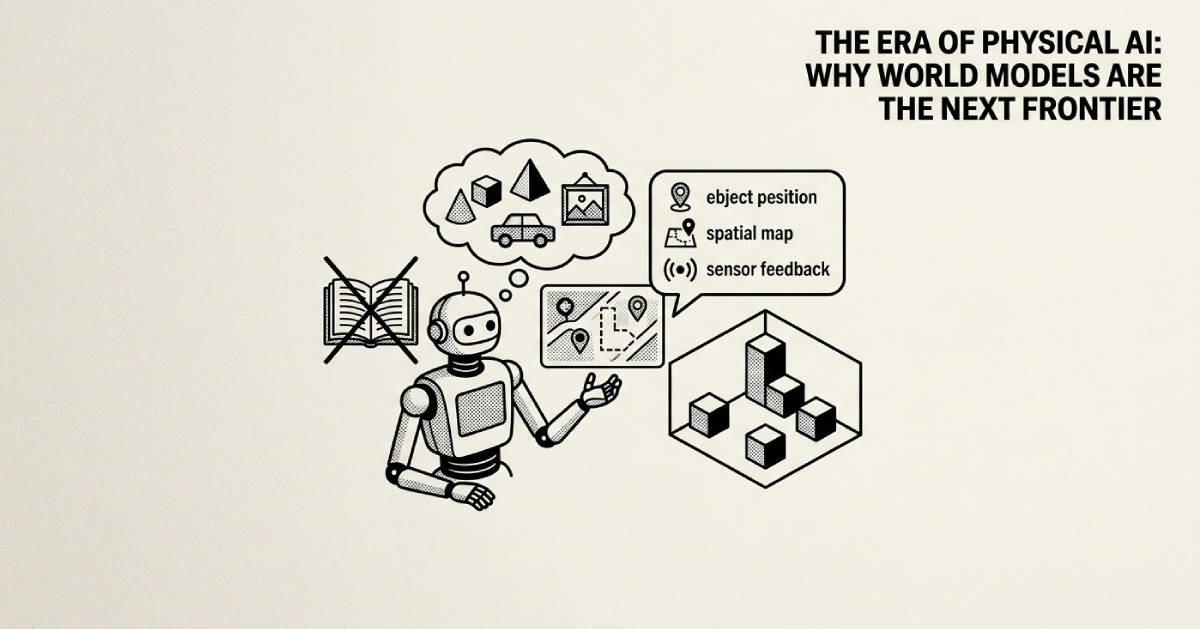
For the past few years, the world has been obsessed with the digital brain. We marveled at large language models that could write poetry, code complex applications, and debate philosophy. But there was always a missing link: the physical world. Digital AI lives in a vacuum of tokens and probabilities. It knows what a coffee cup is because it has read a million descriptions of one, but it does not understand the gravity, the friction, or the fragility of that cup in a real room.
Enter the era of Physical AI. We are moving beyond chatbots and into the realm of embodied intelligence. The most significant breakthrough in this transition is the emergence of Native World Models, exemplified by recent architectures like Kairos. Unlike traditional AI that predicts the next word, a world model predicts the next state of the environment.
What is a World Model?
At its core, a world model is a mental simulation. If you close your eyes and imagine pushing a glass off a table, you can see it fall and hear it shatter. You are not calculating physics equations in your head; you are running a simulation based on your internal model of how the world works. Physical AI attempts to give machines this same capability.
Native world models operate by integrating sensory input directly into a predictive framework. Instead of translating a camera feed into text and then making a decision, these systems process the visual and tactile data as a continuous stream. They learn the “laws” of their environment through observation and interaction, allowing them to anticipate outcomes before they happen.
The Kairos Breakthrough: Efficiency Meets Embodiment
The recent introduction of the Kairos stack highlights a critical shift in how we build these models. Historically, world models required massive computational overhead, making them impractical for real-time robotics. Kairos changes this by using a 4B parameter architecture combined with Hybrid Linear Temporal Attention. This allows the model to maintain a long-term memory of its environment without the linear slowdown typically associated with transformer models.
This efficiency means that intelligence can now live on the edge. A robot no longer needs to send a video stream to a massive server in the cloud to decide how to pick up an egg. The intelligence is native, local, and fast. This is the difference between a remote-controlled drone and a truly autonomous agent.
Why This Matters for the Future
The implications of Physical AI extend far beyond industrial robotics. We are looking at a future where AI can assist in surgery with a nuanced understanding of organic tissue, where autonomous vehicles can navigate unpredictable urban chaos by simulating potential accidents milliseconds before they occur, and where home assistants can actually fold laundry because they understand the geometry of fabric.
We are witnessing the convergence of the digital and the physical. When AI stops being a screen-based experience and starts interacting with the three dimensional world, the definition of productivity changes. We are no longer just optimizing pixels; we are optimizing atoms.
The transition to world models is not just a technical upgrade. It is a fundamental shift in how machines perceive existence. For the first time, AI is not just talking about the world. It is starting to understand how to live in it.