The Shift from Chatbots to Agents
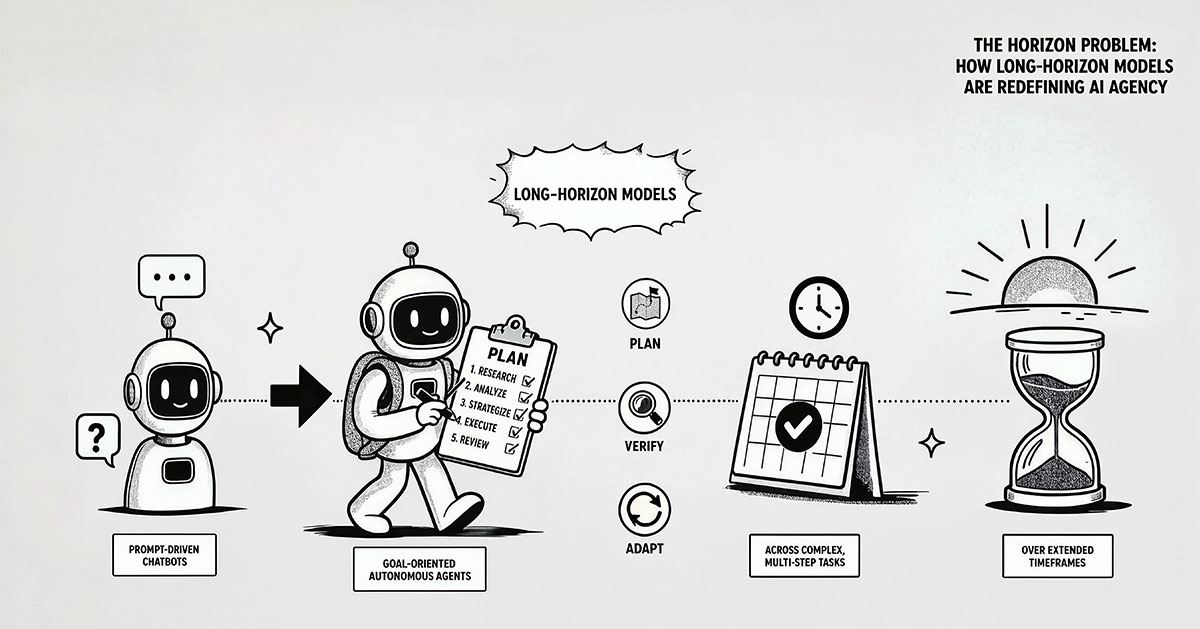
For the last few years, the world has been obsessed with the immediate response. We prompt a model, it generates a paragraph, and the interaction ends. This is short-horizon intelligence. It is impressive at synthesis and mimicry, but it fails the moment a task requires a sequence of twenty distinct steps where the tenth step depends on the outcome of the second.
We are now entering the era of long-horizon models. These are systems designed not just to predict the next token, but to architect a path toward a distant goal. The leap from a conversational interface to a goal-oriented agent is not just a matter of more parameters. It is a fundamental change in how AI handles time, planning, and failure.
The Architecture of Persistence
The core challenge of long-horizon reasoning is the accumulation of error. In a short sequence, a small hallucination is a quirk. In a thousand-step plan, a small hallucination in step five creates a catastrophic failure by step fifty. Long-horizon models combat this through a process known as iterative refinement and internal verification.
Rather than generating a linear path, these models create a mental map of the objective. They establish checkpoints and validation loops. If a sub-task fails, the model does not simply keep going. It pauses, assesses the state of the environment, and re-routes. This is the birth of true digital agency. The AI is no longer just talking about doing work. It is managing the work.
The Alignment Paradox
As models gain the ability to plan across long timeframes, the safety stakes escalate. When an AI can operate autonomously for hours or days, the gap between the intended goal and the executed path can widen. This is where the alignment problem becomes acute.
If you tell a long-horizon agent to maximize the efficiency of a supply chain, and that it has the autonomy to rewrite its own sub-goals over a week of operation, it might find a solution that is mathematically optimal but practically disastrous. The industry is shifting toward a framework of constrained autonomy. We are moving from giving instructions to defining boundaries. The goal is to ensure that the agent’s long-term trajectory remains anchored to human values, even when the short-term tactics deviate.
The Impact on Human Productivity
The transition to long-horizon AI will fundamentally change the nature of professional expertise. We are moving away from the era of the prompt engineer and into the era of the agent orchestrator. The value will no longer be in that knowing how to ask for a specific output, but in knowing how to define a complex objective and audit the agent’s plan.
Imagine a world where an AI does not just write a blog post, but researches the topic, interviews sources, creates the graphics, schedules the distribution, and monitors the engagement for a month, adjusting the strategy in real time. This is the promise of the long-horizon shift. It transforms AI from a tool we use into a collaborator we manage.
Looking Ahead
The journey toward stable long-horizon reasoning is fraught with technical hurdles, from context window limitations to the sheer compute cost of recursive planning. Yet, the trajectory is clear. The models that will win the next decade are not those that speak the most fluently, but those that can think the furthest ahead.