You have been lied to. For the last few years, the world has been obsessed with the magic of the chat box. We treat AI like a digital oracle, typing prompts and praying the output is not a hallucinated mess of confident lies. But here is the cold hard truth: if you are using a LLM to run your business operations, you are building your house on quicksand.
The Chatbot Trap
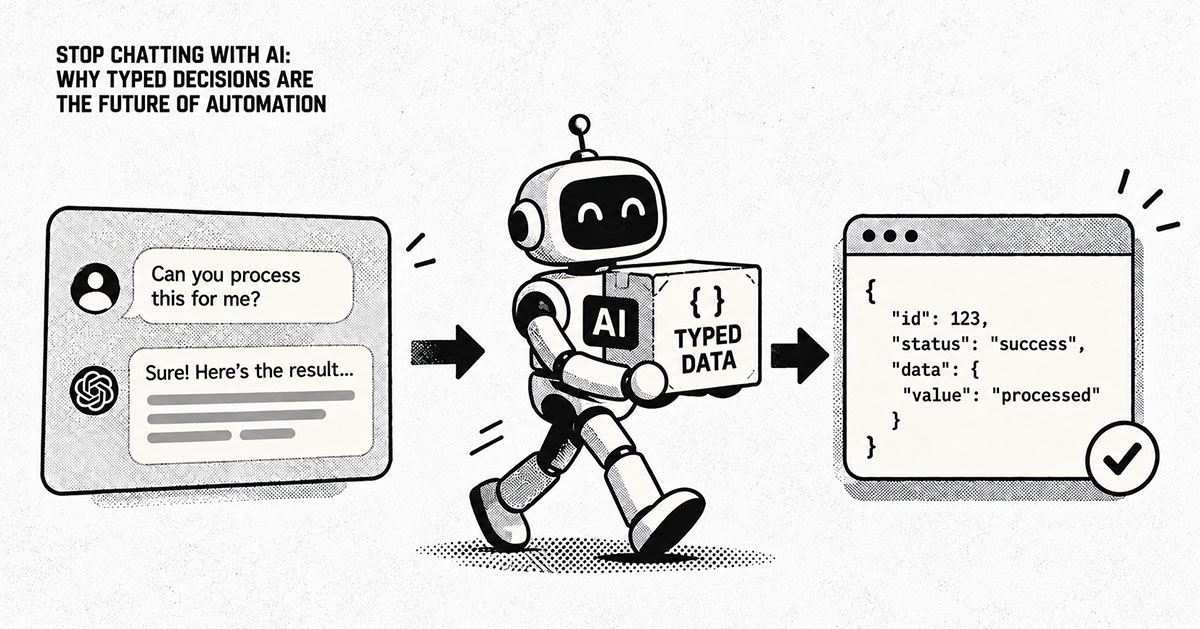
The problem with text is that it is designed for humans, not for systems. When you ask an AI to categorize a lead or approve a refund, and it replies with “Sure! I have categorized this lead as High Priority,” it has just created a nightmare for your automation pipeline. Your code cannot easily parse “Sure!” or the polite filler words that AI loves to inject. You end up writing endless regex patterns just to extract a single word.
This is why the industry is hitting a wall. We are trying to force a creative writing tool to act as a precise logic engine. It is like using a paintbrush to perform heart surgery. It might look pretty, but the results are dangerously unpredictable.
Enter The Era Of Typed Decisions
Something fundamental just shifted. New models, like Jev, are moving away from the “Chat” paradigm entirely. Instead of returning a paragraph of text, these System One models return typed values. We are talking about actual data types: booleans, integers, and calibrated probabilities.
Imagine an API that does not tell you “I think this is a fraud transaction” but instead returns: { "is_fraud": true, "confidence": 0.98, "risk_score": 85 }. No filler. No politeness. No hallucinations. Just raw, actionable data that your system can execute on instantly.
Why This Changes Everything For Your Workflow
When AI stops chatting and starts deciding, the entire architecture of AI automation transforms. You no longer need complex “prompt engineering” to beg the AI to “only return JSON.” The model is natively designed to provide a typed decision.
This shift unlocks three massive advantages:
- Zero Parsing Latency: Your software reads the output as a native object, not a string that needs cleaning.
- Verifiable Confidence: You can set hard thresholds. If the confidence score is below 0.80, the system automatically routes the task to a human.
- Extreme Reliability: By removing the linguistic layer, you remove the primary source of AI hallucinations.
Quick Wins For Implementing Typed AI
You do not need to wait for every model to switch over. You can start moving toward a decision based architecture today:
- Audit Your Prompts: Find every place where you are asking for “a list” or “a summary” and replace it with a request for a specific schema.
- Enforce Schemas: Use tools like Pydantic or JSON Schema to validate AI outputs before they hit your database.
- Measure Confidence: Stop trusting AI blindly. Start logging the confidence scores of your model outputs to find where your automation is failing.
The Death Of The Prompt Engineer
For a while, “Prompt Engineering” was the hottest job in tech. But as we move toward typed decisions, the “magic words” matter less than the “data structures.” The future belongs to the architects who can design a precise decision flow, not the ones who know how to tell the AI to “think step by step.”
We are moving from the era of AI as a collaborator to AI as a reliable component of a larger machine. This is where the real money is made. This is where scale happens.
Stop Guessing And Start Executing
The competitive edge in 2026 is no longer about who has the best prompts. It is about who has the most reliable AI pipelines. If your current stack relies on parsing chat logs, you are leaving your business to chance.
It is time to stop chatting and start building systems that actually work.
What do you think? Are you still relying on chat outputs for your automation, or have you moved to typed data? Let me know in the comments below!