You are staring at a blinking cursor, trying to coax a Large Language Model into doing exactly what you want. You tweak one adjective, add a few examples, and pray to the silicon gods that the output doesn’t hallucinate. We have all been there. But while we were busy mastering the art of the prompt, a quiet revolution happened under the hood. It is called Weight Space Programming, and it is about to make prompting look like using a typewriter in the age of the cloud.
The Death of the Prompt
For the last few years, our relationship with AI has been conversational. We treat the model as a black box and try to influence its behavior through natural language. The problem is that language is imprecise. You can ask for a professional tone, but the model’s version of professional might be a corporate brochure from 1994.
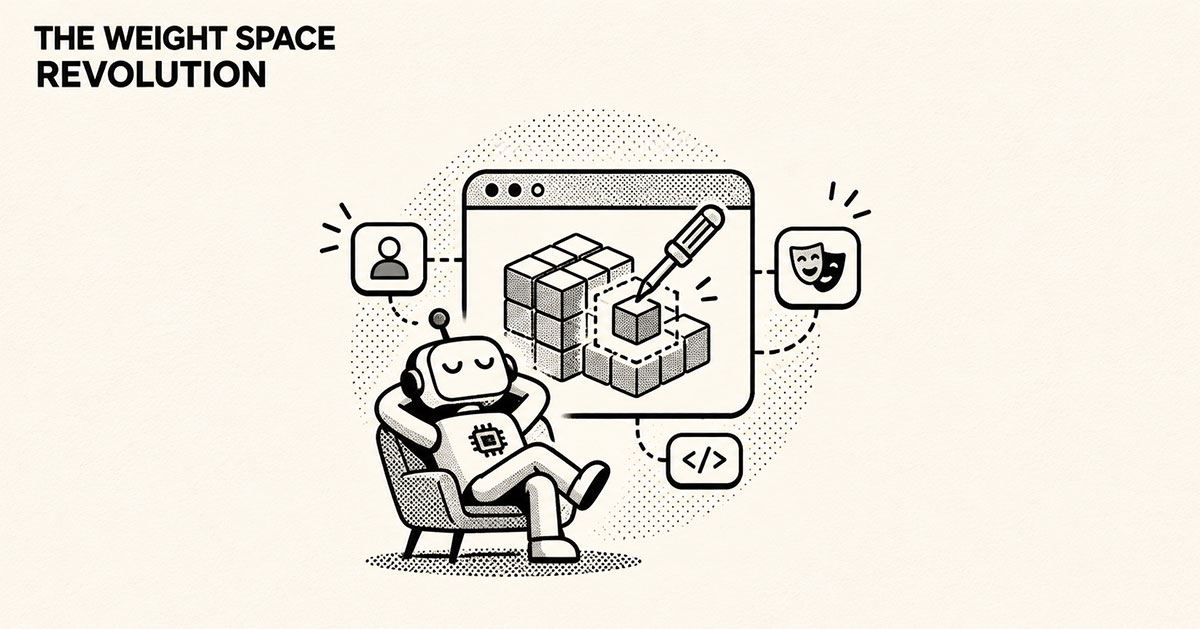
Weight Space Programming flips the script. Instead of talking to the model, we are now talking to the weights. Every AI model is essentially a massive collection of numbers called weights. Traditionally, these are set during training and frozen during inference. Weight space programming allows us to surgically modify these weights in real time to bake specific behaviors, styles, and knowledge directly into the model architecture without the need for a thousand line system prompt.
Why This Changes Everything
Imagine a world where you do not need to tell your AI to be a senior software engineer every time you start a chat. Instead, you load a weight patch that physically reconfigures the model into a coding specialist. This is not just fine tuning. Fine tuning is like sending a student to a four year degree. Weight space programming is like a targeted neural upload.
The efficiency gains are staggering. Because the behavior is embedded in the weights, you save thousands of tokens in your context window. Your latency drops because the model does not have to process a massive set of instructions before it even begins to think. It just is the expert you need it to be.
Practical Wins for the Modern Creator
If you are wondering how to actually use this in your workflow, start by looking at the emerging tools that allow for dynamic weight shifting. Here are a few quick ways to stay ahead of the curve:
- Modular Personas: Stop using system prompts for personas. Start using specialized weight adapters that can be swapped in milliseconds.
- Zero Shot Precision: Use weight patches to enforce strict output formats like JSON or XML without having to beg the model to avoid preamble text.
- Hyper Localized Knowledge: Instead of stuffing a PDF into the context window, use small, targeted weight updates to integrate specific datasets directly into the model’s latent space.
The Technical Deep Dive: How It Actually Works
At its core, this involves manipulating the tensors that define the model’s neural connections. By applying specific mathematical transformations to the weight matrices, we can shift the probability distribution of the model’s outputs. This is often done through Low Rank Adaptation or LoRA, but the new frontier is moving toward active, runtime weight manipulation.
When you apply a weight patch, you are essentially telling the model: In this specific context, prioritize these neural pathways over those. It is a level of control that prompt engineering can never achieve because it bypasses the linguistic layer entirely and operates on the mathematical foundation of the AI.
The Future is Weights, Not Words
We are moving toward a future where AI models are not monolithic blocks of intelligence, but fluid canvases. You will have a base model that provides general reasoning, and you will layer on top of it a series of weight patches tailored to your specific needs for that hour of the day.
The barrier to entry is dropping. You will soon be able to download weight patches from a marketplace just as you download plugins for a browser. One patch for legal analysis, one for creative storytelling, and one for high conversion copywriting. The interface will no longer be a chat box, but a control panel for your AI’s cognitive architecture.
Your Move: Get Ahead of the Curve
The window to be an early adopter of weight space programming is open right now. Most people are still fighting with their prompts, which means the competitive advantage for those who understand the weights is massive. Stop trying to find the perfect magic word. Start exploring how to shape the intelligence itself.
What do you think? Is the era of the prompt engineer over, or is this just another tool in the kit? Drop a comment below and let me know if you have tried using LoRAs or weight adapters in your projects. Share this with a friend who is still spending three hours a day on a single prompt.