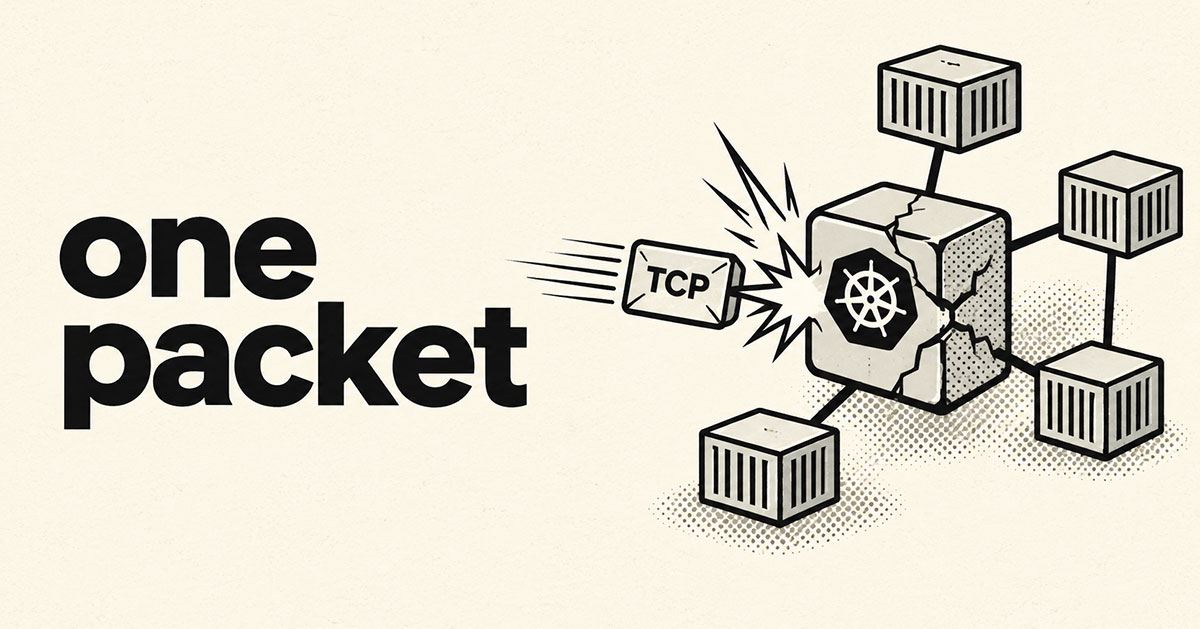
One malformed TCP exchange can crash a Linux node while every Kubernetes Pod still reports healthy. The GKE TCP vulnerability in Google’s 19 November 2026 bulletin, CVE-2026-99288, puts node availability on the security checklist for clusters running Container-Optimized OS or Ubuntu images. This is a denial-of-service issue, not a new Kubernetes container-escape flaw. The failure sits below application logic itself.
Key Takeaway: CVE-2026-99288 is a Linux kernel TCP denial-of-service flaw, not a container escape or remote-code-execution bug. GKE Standard and Autopilot clusters can be affected when vulnerable control planes or nodes expose reachable TCP listeners. Inventory node images and endpoints, then upgrade to Google’s listed fixed versions where available and track outstanding Ubuntu patches.
What Actually Changed?
Google published GKE bulletin GCP-2026-088 on 19 November. It describes a kernel panic triggered by specially crafted TCP traffic reaching a listener on a node, Pod, or the cluster control plane’s IP-based endpoint; traffic originating inside the same VPC can also be relevant.
The underlying issue is a race in lockless TCP established-socket lookups. Socket memory can be recycled while a lookup still holds an old address, and the lookup can accept a newly reused object without confirming that it is still present in the socket hash. The resulting path can dereference a null listener and crash the kernel.
The Linux kernel CVE announcement identifies the fix as rejecting unhashed sockets during established lookups. It lists upstream fixes in Linux 6.12.117, 6.18.63, and 7.3.4, but those upstream numbers are not a substitute for checking a cloud vendor’s backported build.
Google rates the GKE issue High. Its bulletin says Standard and Autopilot clusters using Container-Optimized OS or Ubuntu are in scope, including control planes and worker nodes; GKE Sandbox (gVisor) Pods and Windows Server node pools are not affected. At publication, Google listed fixed Container-Optimized OS builds for GKE 1.34, 1.35, and 1.36, while Ubuntu and several other minor-version builds were still in progress.
Why Does This Matter for Engineering and Product Teams?
The practical risk is availability, not data theft or privilege escalation from this CVE. A kernel panic affects the node, so every workload scheduled there can lose service together; a replica on another node helps only if the cluster has spare capacity and traffic can be rescheduled.
Do not read “containerized” as “isolated from kernel failure.” Containers share the host kernel, and a kernel-level fault crosses the boundary between separate Pods. The blast radius therefore depends on node placement, replica spread, disruption budgets, and the ability to replace or drain unhealthy capacity.
Google’s exposure notes are configuration-specific. External and cross-project traffic is the main concern, but same-VPC traffic can also trigger the issue; private nodes exposed only through Layer 7 load balancers or proxy Network Load Balancers reduce direct external TCP reachability because those frontends terminate connections upstream. Control planes using only DNS endpoints or private IP endpoints also avoid the relevant public IP path.
| Design assumption | What this bulletin changes |
|---|---|
| Pods are separate security units | A shared kernel panic can interrupt every Pod on that node |
| A private cluster has no network exposure | Same-VPC traffic can still be relevant |
| Readiness probes guarantee resilience | They do not prevent a host kernel crash |
| One replica is enough | Replicas need independent nodes and spare capacity |
For teams building business-critical platforms, this is an infrastructure design issue as much as a patching task. Emetrio’s custom web application development and broader software and digital services provide the delivery context; production resilience still depends on how the platform is operated.
How Should You Adapt Your Stack This Week?
Start with the actual cluster configuration, not a generic CVE scanner result. Google’s bulletin specifies images, exposure, and patch availability.
1. Map control planes and node pools
- Export cluster inventory: Record GKE mode, region, release channel, control-plane and node-pool versions, node image type, and whether each pool uses Container-Optimized OS or Ubuntu.
- Map reachable listeners: Review node services, Pod TCP services, control-plane IP endpoints, authorized networks, and same-VPC or cross-project paths.
- Mark exclusions: Separate GKE Sandbox Pods and Windows Server node pools, but do not use those exclusions to dismiss exposure elsewhere.
2. Upgrade to the matching fixed build
- For Container-Optimized OS: Google lists 1.36.6-gke.1189000, 1.35.10-gke.1155000, and 1.34.13-gke.1091000 or later. Match the patch to the cluster’s minor version and release channel.
- For Ubuntu and other minor versions: The 19 November bulletin says fixes are still in progress. Track the GKE bulletin rather than assuming a generic kernel update changes a managed node image.
- Verify both layers: Check control-plane and node-pool status after upgrading. For Autopilot, follow Google’s managed upgrade process and confirm the cluster reaches a fixed release.
3. Reduce blast radius while fixes roll out
- Restrict network paths: Limit access to node and control-plane TCP listeners using authorized networks, firewall rules, private endpoints, and upstream Layer 7 termination where suitable. Include internal VPC routes.
- Test workload recovery: Confirm replicas span separate nodes, disruption budgets allow safe maintenance, and autoscaling has quota and capacity to replace failed nodes.
- Exercise the runbook: In staging, validate node replacement, traffic shifting, alerting, and recovery time. Assign an owner and review date to every pool awaiting a patch.
Do not apply random kernel flags or disable SYN cookies on GKE because another distribution lists that mitigation. Use vendor-supported controls and avoid weakening SYN-flood protection without a tested risk decision.
Frequently Asked Questions
Can CVE-2026-99288 let an attacker escape a Kubernetes container?
No. Google describes this CVE as a kernel denial-of-service issue, not privilege escalation or container breakout. A kernel panic can still interrupt every workload on the affected node and cause a wider service outage.
Are GKE Autopilot clusters affected by CVE-2026-99288?
Yes. Google lists both GKE Standard and Autopilot clusters running affected Container-Optimized OS or Ubuntu versions. GKE Sandbox Pods and Windows Server node pools are excluded from this specific issue.
Which GKE versions contain the fix?
Google lists Container-Optimized OS fixes for GKE 1.34.13-gke.1091000, 1.35.10-gke.1155000, and 1.36.6-gke.1189000 or later. Ubuntu and several other minor-version patches were still in progress in the 19 November bulletin, so check before scheduling an upgrade.
The Bottom Line
CVE-2026-99288 is a reminder that Kubernetes availability depends on the host kernel, network reachability, and workload placement, not just healthy Pods. Audit the actual GKE image and endpoint configuration, upgrade to the correct vendor build, and test recovery before the next node failure does it.
If your team needs to review a cloud architecture, strengthen application resilience, or build a production-ready digital product, contact Emetrio to plan the work.