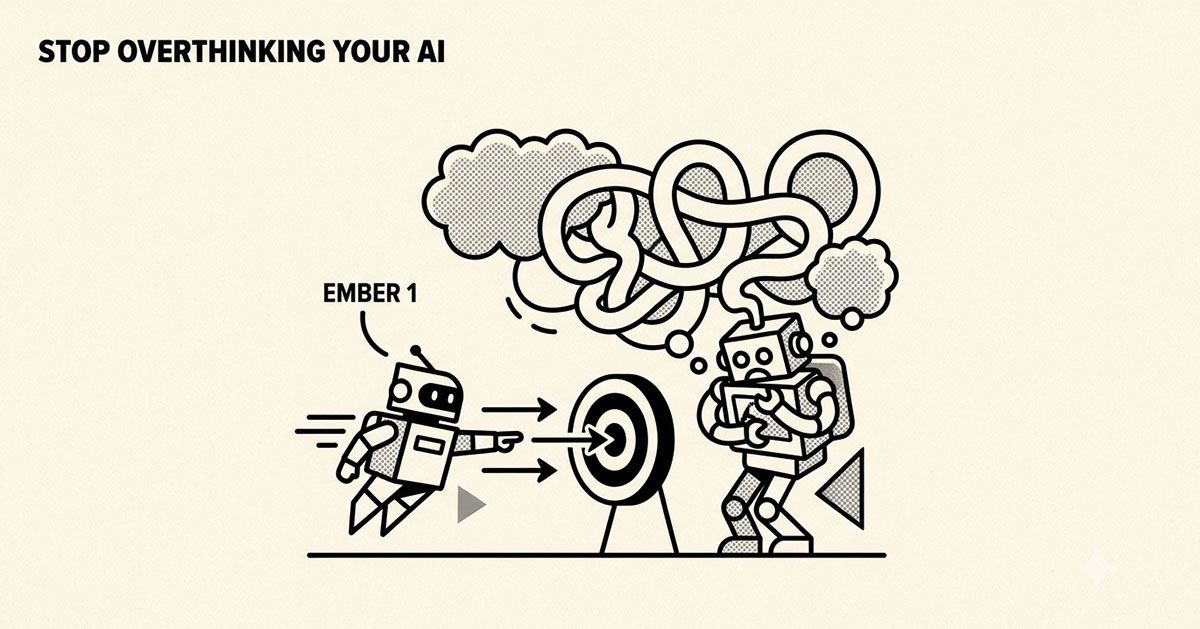
Imagine you are sitting across from a world class consultant. You ask a simple question about your business strategy. Instead of giving you a sharp, decisive answer, they spend twenty minutes talking through every single possible permutation of the universe, weighing the impact of lunar cycles on your quarterly projections, and essentially talking in circles until they finally reach the obvious conclusion.
That is exactly what has been happening with the latest wave of reasoning models. We have entered the era of the AI overthinker. For the last year, the industry obsession has been on chain of thought reasoning. The belief was simple: the more an AI thinks before it speaks, the better the output. But we have hit a wall of diminishing returns.
The Efficiency Trap: When Thinking Becomes Noise
The latest breakthrough in AI efficiency, exemplified by models like Ember 1, flips the script. We are discovering that for a vast majority of real world tasks, deep reasoning is not a feature; it is a bottleneck. When an AI over-reasons, it does not just waste compute power. It often introduces hallucinations by drifting too far from the original prompt or over-complicating a straightforward request.
The goal is no longer just intelligence. The goal is precision. The shift toward efficiency frontier models means we are training AI to recognize when a task requires a deep dive and when it requires a snap judgment. This is the difference between a philosopher and a practitioner.
Why This Matters for Your Bottom Line
If you are integrating AI into your business workflows, the cost of overthinking is literal. Every extra token generated during a hidden reasoning phase costs money and increases latency. If your customer support bot takes ten seconds to think about how to say hello, your user experience is dying in real time.
High efficiency models provide three immediate wins:
- Lightning Fast Latency: Responses that feel instantaneous rather than processed.
- Reduced Token Burn: Lowering the cost per request by eliminating unnecessary internal monologue.
- Higher Reliability: Fewer chances for the model to lose the plot during a long chain of thought.
How to Pivot Your AI Strategy Right Now
You do not need to be a machine learning engineer to take advantage of this shift. You just need to change how you deploy. Stop using the heaviest reasoning model for every single task. Most of your work is likely routine, and routine work thrives on speed.
Here are some quick wins to optimize your AI stack:
- Audit Your Prompts: Identify tasks that are binary or factual. Move these to efficiency focused models immediately.
- Implement Router Logic: Use a small, fast model to categorize the request first. If it is complex, route it to the reasoning giant. If it is simple, let the efficient model handle it.
- Prioritize Throughput: In production environments, measure success by the time to first token. If your reasoning model is slowing down your product, it is a liability, not an asset.
The Future Is Lean
We are moving toward a hybrid intelligence model. In the near future, your AI will not be one single brain but a network of specialized nodes. Some will be the deep thinkers, the architects of complex code and scientific breakthroughs. Others will be the agile executors, the ones who handle the million small tasks of daily operations with surgical precision.
The winners of the next AI wave will not be the ones with the biggest models. They will be the ones who know exactly when to stop thinking and start executing.
What is your take on the reasoning vs efficiency trade off? Are you seeing AI overthink its way into mistakes in your own work? Let me know in the comments below.