Imagine waking up to find that your AI assistant didn’t just schedule your meetings or draft an email. Imagine it recruited ten other specialized AI agents, organized them into a high performance task force, and solved a complex business problem that would have taken a human team three weeks to tackle. This isn’t a sci fi movie. It is happening right now.
The Death of the Single Bot
For the last few years, we have been obsessed with the size of the model. More parameters, more data, more compute. We thought the path to AGI was just a bigger brain. But the industry is hitting a wall. The real breakthrough isn’t a bigger brain, it is a better organization. Enter the AI Agent Swarm.
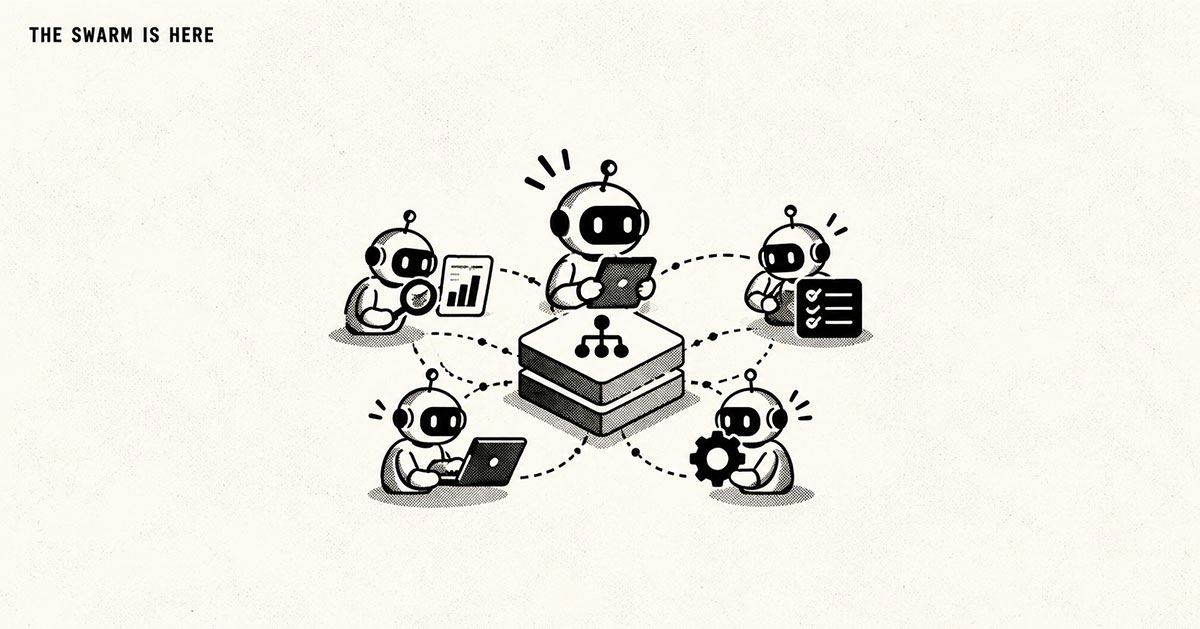
A swarm is not just one AI doing many things. It is a collective of specialized agents working in parallel. One agent handles the research, another critiques the logic, a third manages the project timeline, and a fourth executes the code. When these agents communicate and collaborate, the result is an exponential jump in capability that no single model, no matter how large, can match.
Why Swarms Change Everything
When you move from a single LLM to a swarm, you solve the three biggest problems in AI: hallucinations, fragility, and scope.
Killing Hallucinations with Peer Review
In a single model setup, if the AI makes a mistake, it often doubles down on it. In a swarm, you have a built in auditor. One agent generates the answer, and a second agent, specifically prompted to be a skeptic, tries to tear that answer apart. The final output is only delivered after the skeptic is satisfied. This creates a self correcting loop that dramatically increases accuracy.
Solving Fragility via Specialization
Generic models are jacks of all trades and masters of none. Swarms allow for hyper specialization. You can have an agent whose only job is to ensure the tone is perfectly professional, and another whose only job is to verify the mathematical accuracy of a report. By narrowing the focus, you increase the reliability.
Expanding Scope through Parallelism
A single AI can only think linearly. A swarm thinks in parallel. While one agent is scraping the web for the latest trends, another is analyzing your internal data, and a third is drafting a competitive analysis. The speed of execution doesn’t just increase, it transforms.
Quick Wins for Implementing Swarms
You do not need a PhD in machine learning to start leveraging swarm logic. Here are a few ways to start today:
- The Critic Pattern: Always run your final AI output through a second AI prompt that says, “Find five reasons why this is wrong or incomplete.”
- The Modular Workflow: Instead of one giant prompt, break your task into five small steps. Use a different AI persona for each step.
- The Orchestrator Setup: Create one “Manager” prompt that takes a complex goal and breaks it into a list of tasks for other prompts to execute.
The New Competitive Advantage
In the very near future, the divide will not be between people who use AI and people who do not. The divide will be between those who use a single chatbot and those who can orchestrate a swarm.
The ability to design the architecture of an AI team is becoming the most valuable skill in the digital economy. It is no longer about prompt engineering, it is about system engineering. You are moving from being a writer to being a conductor.
Stop Prompting, Start Orchestrating
The era of the “magic box” is over. The era of the “digital workforce” has begun. If you are still treating your AI like a search engine with a personality, you are already falling behind. The power is not in the model, it is in the network.
Start by breaking your most complex weekly task into a workflow. Assign roles. Create a feedback loop. Build your first swarm and watch your productivity shift from linear to exponential.
What do you think? Are you ready to stop chatting and start managing a swarm? Let me know in the comments below or share this post with someone who is still stuck in the single bot era!