The Autoregressive Ceiling
For years, the world of Large Language Models has been dominated by a single paradigm: autoregressive generation. Whether you are using GPT-4 or Claude, the process is essentially the same. The model predicts the next token based on all preceding tokens. It is a linear, one-word-at-a-time march forward. While this has yielded incredible results, it comes with a fundamental limitation. The model cannot go back and fix a mistake made at the start of a paragraph. It cannot plan a global structure with precision because it is always focused on the very next step.
The Rise of Diffusion for Text
Enter Diffusion Language Models (DLMs). To understand them, we must look at how AI generates images. Models like Stable Diffusion do not draw a picture pixel by pixel from left to right. Instead, they start with a canvas of pure noise and gradually refine it into a clear image. They look at the whole picture at once and iteratively polish it.
Applying this to text is a massive technical challenge. Images are continuous data, but text is discrete. You cannot have a half-word or a blurry letter. However, new research from Google and other labs is bridging this gap. By mapping text into a continuous embedding space, DLMs can start with a sequence of random noise and refine the entire block of text simultaneously.
Why This Changes Everything
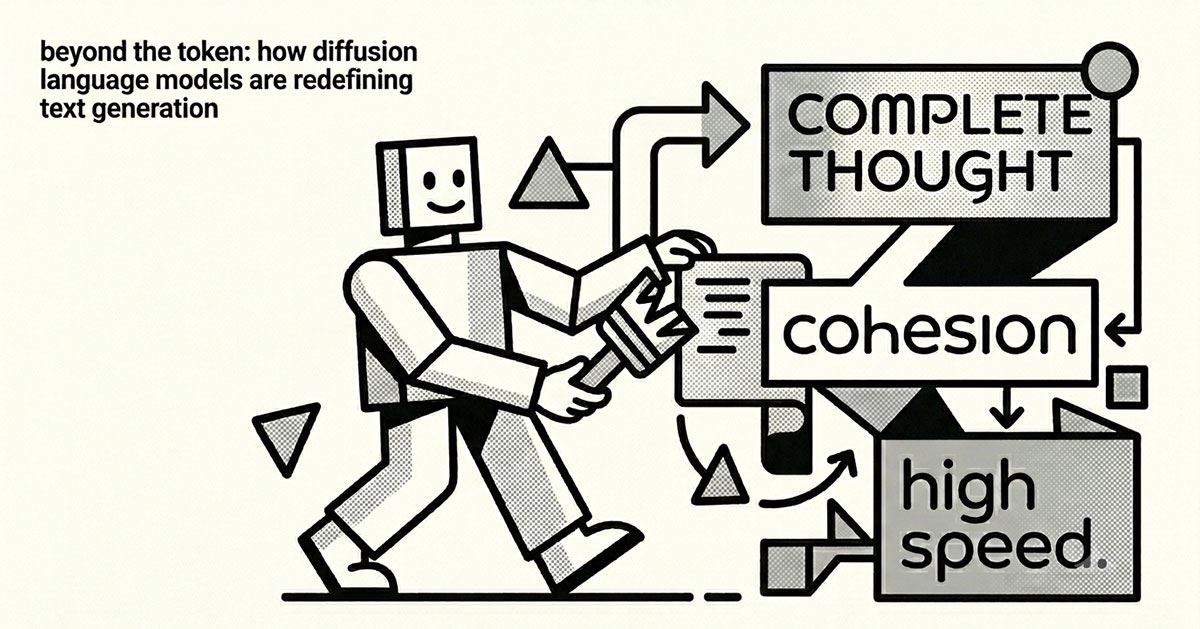
The implications for content quality are profound. First, we gain global coherence. Because a DLM refines the entire response at once, it can ensure that the conclusion of a long essay perfectly aligns with the introduction. There is no drifting off course.
Second, we see a leap in efficiency. Parallel generation means we are no longer tied to the linear speed of token output. We can generate complex structures in a fraction of the time it takes an autoregressive model to loop through thousands of tokens.
Third, it opens the door to true iterative editing. A model could generate a draft and then perform a second pass to refine the tone or check for factual consistency across the whole document without needing to regenerate the entire sequence from scratch.
The Road to Implementation
We are not yet at the point where DLMs replace Transformers entirely. The Transformer architecture still reigns supreme for general purpose reasoning. But we are seeing a hybrid future. Imagine a system where a Transformer plans the high level logic and a Diffusion model handles the fluid, high quality prose generation.
As we move toward 2027, the focus will shift from simply scaling parameters to refining the very method of generation. The goal is no longer just predicting the next word. The goal is sculpting the perfect response.