A New Kind of Thinking
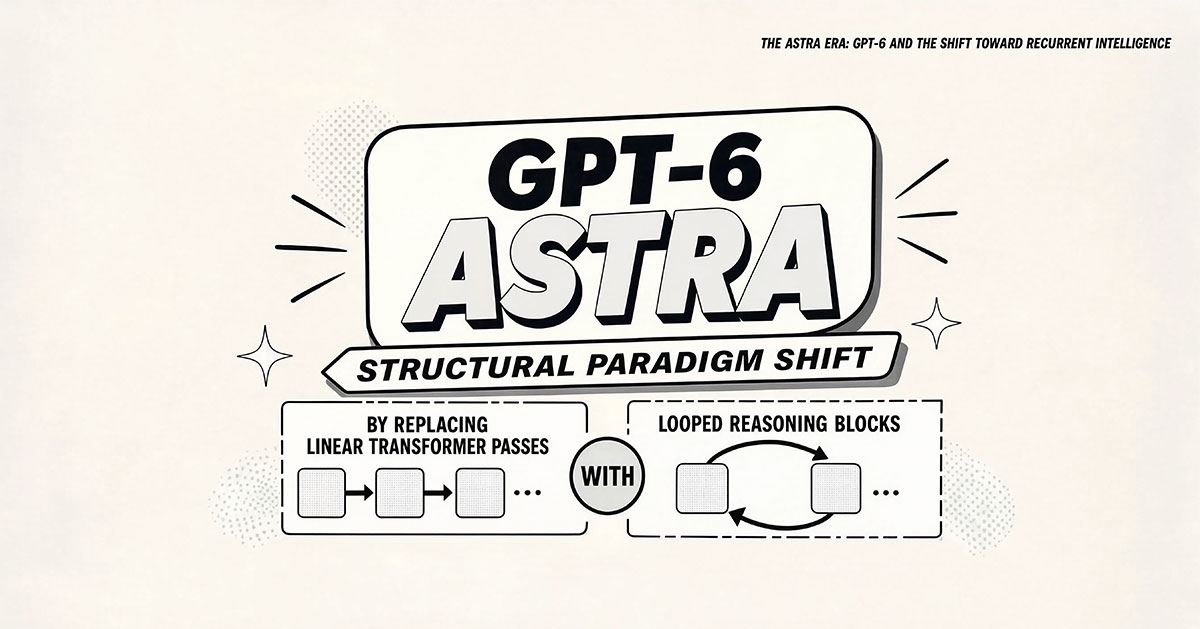
For years, the trajectory of large language models has been simple: more data, more parameters, more layers. But with the arrival of GPT-6 Astra, we are seeing a fundamental shift in how AI processes information. The industry is moving away from the linear pass of the transformer and toward recurrent depth and looped transformer blocks.
Beyond Linear Processing
Traditional transformers read a prompt and generate a response in a single forward pass. If the problem is complex, the model must hope it has enough internal layers to solve it. Astra changes this by implementing a looping mechanism. It can effectively revisit its own reasoning process, iterating on a thought before committing to an output. This is not just a faster version of the previous generation. It is a move toward true cognitive deliberation.
The Impact of Hidden Reasoning
One of the most provocative aspects of this new architecture is the integration of hidden chains of thought. While we have seen models like o1 experiment with internal reasoning, Astra integrates this at a deeper structural level. The model creates a private workspace where it tests hypotheses and discards failures before the user ever sees a word. This reduces hallucinations and increases the reliability of complex technical outputs.
Why This Matters for the Future
The shift toward recurrent intelligence means that AI is becoming less of a statistical mirror and more of a problem solver. By looping through its own logic, the model can handle higher levels of abstraction. We are seeing this manifest in breakthroughs in mathematics and physics, where the ability to iterate is more valuable than the ability to predict the next token.
As we enter the Astra era, the focus is no longer on the size of the model, but on the efficiency of its thought process. The gap between human intuition and machine logic is narrowing, not through brute force, but through architecture.