The promise of Large Language Models (LLMs) has always been their versatility. We are told that these systems can act as coders, poets, strategists, and analysts. However, a growing body of research suggests that this versatility is fragile. When we push a model into a specific, restrictive behavioral corner through poor prompting, we encounter a phenomenon known as pigeonholing. This is not merely a case of the model failing to follow instructions. It is a structural collapse of the model’s reasoning capabilities triggered by the prompt itself.
Understanding the Mechanics of Pigeonholing
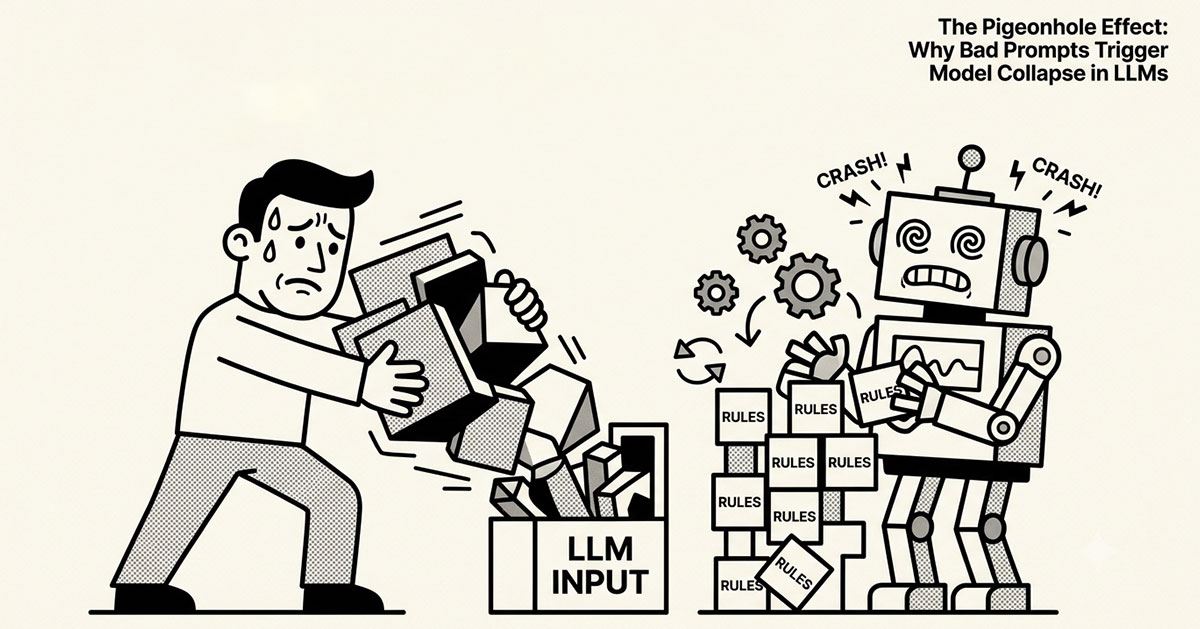
At its core, pigeonholing occurs when a prompt restricts the output space of a model so severely that it overrides the model’s internal logic. When a model is forced to adhere to an overly rigid format or a contradictory persona, it often stops performing the actual task and starts focusing entirely on the constraints. This creates a feedback loop where the model prioritizes the appearance of the correct format over the accuracy of the content.
For example, if a prompt demands that a model answer a complex mathematical question using only a specific set of words or a highly unnatural structure, the model may enter a state of cognitive dissonance. Instead of solving the math, it spends its computational budget trying to fit the answer into the narrow pigeonhole provided. The result is often a confident but entirely incorrect response, as the model collapses into a pattern matching mode rather than a reasoning mode.
The Path to Model Collapse
Model collapse is usually discussed in the context of training data, specifically when models are trained on AI generated content. However, pigeonholing introduces a runtime version of collapse. When a prompt is too restrictive, the model’s latent space is effectively pruned. The vast web of associations that allow an LLM to make creative leaps or solve novel problems is bypassed in favor of a narrow path.
This collapse manifests in several ways. First, there is a noticeable drop in nuance. The model begins to rely on clichés and repetitive phrasing. Second, there is an increase in hallucinations. Because the model is struggling to satisfy the prompt constraints, it may invent facts that fit the required format better than the truth would. Third, the model loses the ability to self correct. Once it has fallen into the pigeonhole, it often cannot see the error in its logic because the constraint is now the primary lens through which it views the task.
The Danger of Over Prompting
Many power users believe that the key to better output is more detailed prompting. While specificity is generally good, there is a tipping point where detail becomes a constraint. When we provide twenty different rules for how a response should look, we are not guiding the model. We are building a cage.
Over prompting leads to what researchers describe as a loss of generalizability. The model stops acting like a general intelligence and starts acting like a brittle script. If the prompt is too rigid, any slight variation in the input can cause the entire output to fail. This brittleness is the hallmark of a pigeonholed model.
Strategies for Avoiding the Pigeonhole
To prevent this collapse, it is essential to shift from restrictive prompting to objective based prompting. Instead of telling a model exactly how to behave, tell it what the successful outcome looks like. Provide examples of high quality work rather than a list of forbidden behaviors.
Allowing the model some breathing room in its output format often leads to higher reasoning quality. If the format is critical, request the reasoning process in a separate block first. By allowing the model to think through the problem in a natural way before formatting the final answer, you separate the reasoning phase from the constraint phase. This prevents the constraints from poisoning the logic.
The goal is to maintain the model’s access to its full latent space. By treating the LLM as a collaborator with its own internal logic rather than a programmable typewriter, we can leverage the true power of these systems without triggering the collapse that comes from pigeonholing.