The landscape of web development is undergoing a seismic shift. For decades, the industry followed a linear progression: from static HTML pages to dynamic CMS-driven sites, and eventually to the complex, microservice-oriented architectures of the modern era. Today, we are entering the fourth industrial revolution of the web—the era of AI-integrated development. At the intersection of cloud computing and machine learning, a new paradigm is emerging where artificial intelligence is not just an added feature, but the core engine driving the development lifecycle.
The Shift Toward AI-Augmented Workflows
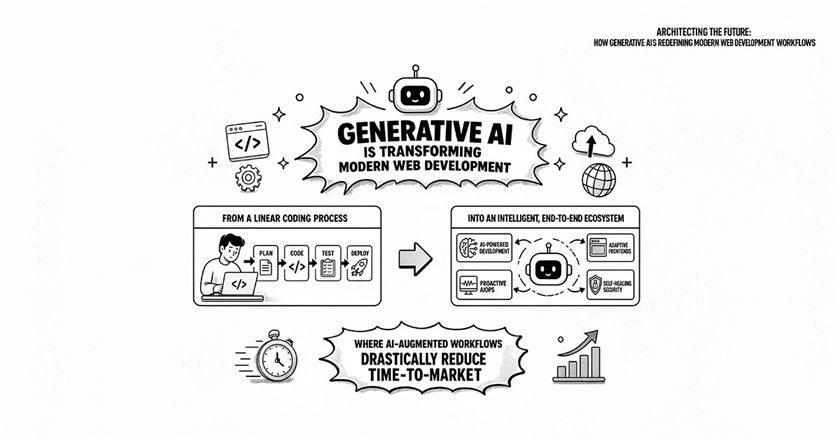
For IT professionals and technology leaders, understanding this shift is critical. Generative AI is no longer confined to chatbots or image generation; it has permeated the very fabric of how we write code, manage infrastructure, and deliver user experiences. As an AI-based development firm, we have observed that companies leveraging AI-augmented workflows are seeing a 40% reduction in time-to-market while simultaneously increasing the robustness of their codebases. But how exactly is this transformation taking place?
Intelligent Code Generation and Refactoring
One of the most significant impacts is seen in the realm of Intelligent Code Generation and Refactoring. Modern Large Language Models (LLMs) have evolved beyond simple autocomplete functions. They are now capable of understanding complex architectural patterns and suggesting optimizations that align with industry best practices. By integrating AI into integrated development environments (IDEs), developers can automate boilerplate code generation, allowing them to focus on high-level logic and creative problem-solving. This doesn’t replace the developer; rather, it elevates their role to that of an architect who orchestrates AI-driven agents to build more resilient systems.
Adaptive Frontend Development and User Experience (UX)
Furthermore, AI is revolutionizing the way we approach Frontend Development and User Experience (UX). Traditional web services often struggle with true personalization. However, by utilizing AI models that analyze user behavior in real-time, developers can now build ‘adaptive interfaces.’ These are web applications that reorganize their UI components, content delivery, and navigation paths based on individual user intent. This level of hyper-personalization was previously impossible to achieve manually at scale. Through AI-driven A/B testing and automated UI component generation, modern web services are becoming more intuitive and accessible than ever before.
AI-Driven DevOps (AIOps) and Backend Management
On the backend, the management of microservices and serverless architectures is becoming increasingly complex. This is where AI-driven DevOps (AIOps) comes into play. By implementing machine learning algorithms within CI/CD pipelines, development teams can predict deployment failures before they occur. AI can monitor system health, detect anomalies in traffic patterns, and automatically scale resources to meet demand, ensuring 99.99% uptime with minimal human intervention. This proactive approach to infrastructure management reduces technical debt and allows for more frequent, lower-risk deployments.
Proactive and Self-Healing Security
Security, a paramount concern for any global web service, is also being fortified by AI. Traditional signature-based security measures are often one step behind sophisticated cyber threats. Modern AI-based security frameworks utilize behavioral analysis to identify zero-day vulnerabilities and mitigate DDoS attacks in real-time. By training models on vast datasets of historical threat patterns, we can now build web services that are inherently self-healing and capable of defending themselves against evolving exploits.
Enterprise Transformation and Business Adoption
As we look toward the future, the role of the AI-based development company is to bridge the gap between these advanced technologies and practical business applications. For enterprises, the transition to AI-integrated web services is not just about adopting new tools; it is about a cultural shift toward data-driven decision-making and automated efficiency. The integration of AI into the software development life cycle is creating a new standard for quality and performance on the global stage.
Conclusion
In conclusion, the fusion of AI and modern web development is a transformative force that is here to stay. By embracing AI-augmented workflows, intelligent architectures, and proactive security measures, businesses can deliver superior digital products that meet the demands of an increasingly sophisticated global audience. The future of the web is intelligent, adaptive, and automated—and the journey is only just beginning.