Artificial intelligence has spent the last few years learning how to understand and generate digital information. It can write text, create images, produce videos, analyze data, and solve complex problems. But the next major shift is already beginning. AI researchers are increasingly focused on systems that can understand how the physical world actually works. These systems, often called world models, are designed to understand spaces, objects, movement, cause and effect, and what may happen after an action is taken. This could move AI from being mainly a digital intelligence into technology capable of reasoning about the real world.
From Generating Content to Understanding Environments
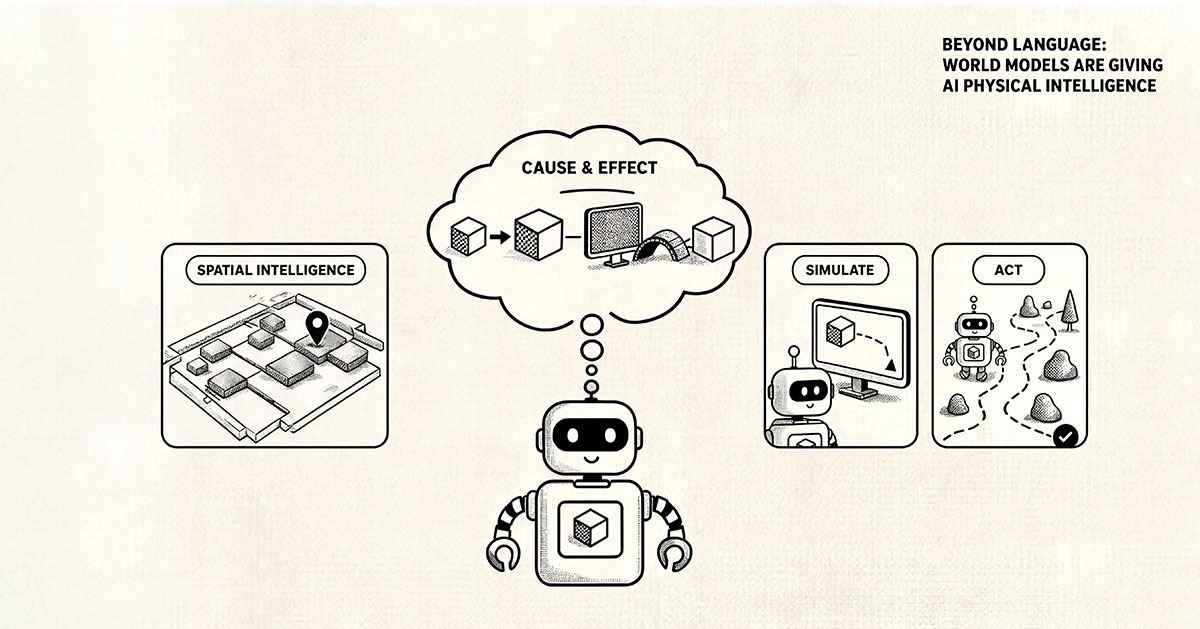
Most generative AI systems are extremely good at recognizing patterns and producing new content based on what they have learned. However, understanding a physical environment requires something different. An intelligent machine operating in the real world needs to know that objects have size, distance, weight, position, and physical limits. It must understand that moving one object can affect another and that an action can change what happens next. World models aim to give AI an internal representation of these relationships. Instead of simply identifying what exists in a scene, the system can begin reasoning about how that scene may change over time. This represents an important transition from AI that mainly recognizes information to AI that can model environments and predict possible outcomes.
AI Is Learning to Predict Before Acting
One of the most powerful ideas behind world models is the ability to simulate possible actions before performing them. Humans naturally do something similar every day. Before moving a chair through a narrow doorway, for example, we can imagine whether it will fit and adjust our movement. Future AI systems could use internal simulations in a similar way. An autonomous system may consider several possible actions, predict their likely results, and select the safest or most effective option. This ability could become especially important in situations where mistakes are expensive or dangerous. Instead of relying only on previous instructions or reacting after something happens, AI could increasingly evaluate consequences before making a decision.
Robotics Could Become Far More Adaptable
Robotics may be one of the biggest areas transformed by spatial intelligence. Traditional robots are often designed for highly structured environments where objects, movements, and tasks are predictable. But the real world is constantly changing. Objects move, people enter spaces, lighting changes, and unexpected obstacles appear. A robot with a stronger world model could understand these changing conditions instead of depending entirely on fixed instructions. It could identify objects, understand their position, estimate how they might move, and adjust its actions accordingly. This could support more flexible robots in manufacturing, warehouses, agriculture, construction, healthcare environments, homes, and many other industries. The long-term goal is not simply a robot that follows commands, but one that understands enough about its surroundings to complete tasks safely in unfamiliar situations.
Digital Simulations Could Become Training Grounds for Intelligence
Another major development is the growing connection between AI and simulation. Training intelligent machines entirely in the physical world can be slow, expensive, and risky. Virtual environments provide another option. AI systems can experience thousands or even millions of simulated situations without damaging real equipment or putting people at risk. A system could learn how objects behave, test different strategies, make mistakes, and improve before interacting with the real environment. Research in simulation-to-reality learning is already exploring how knowledge developed inside virtual environments can transfer to physical machines. As simulation quality improves, digital worlds could become massive training environments where future AI systems learn about physics, navigation, manipulation, and decision-making before they ever operate in the real world.
The Challenge Is Building Reliable Understanding
Giving AI a model of the physical world also creates difficult technical and safety problems. The real world contains uncertainty, and even a highly detailed simulation cannot perfectly represent every possible situation. An incorrect prediction from a chatbot may produce a bad answer, but an incorrect prediction from a machine controlling physical equipment could have much greater consequences. Developers will therefore need better evaluation methods, stronger safety systems, continuous environmental feedback, and clear limits on autonomous behavior. World models must also understand when their predictions are uncertain. Building physical intelligence will not simply require larger AI models. It will require systems that combine perception, memory, reasoning, simulation, planning, and real-time feedback in a reliable way.
Final Thoughts
The next chapter of artificial intelligence may be defined by something larger than better conversations or more realistic generated content. AI is beginning to move toward understanding environments themselves. World models and spatial intelligence could allow machines to reason about objects, movement, physics, and the consequences of actions before interacting with the real world. This shift could reshape robotics, autonomous machines, industrial automation, simulation, engineering, and many technologies that have not yet been imagined. The AI revolution started with machines learning our language. Its next major challenge may be learning the world that language describes.