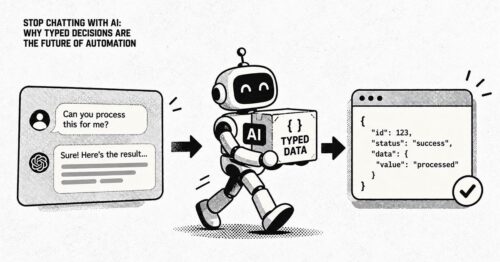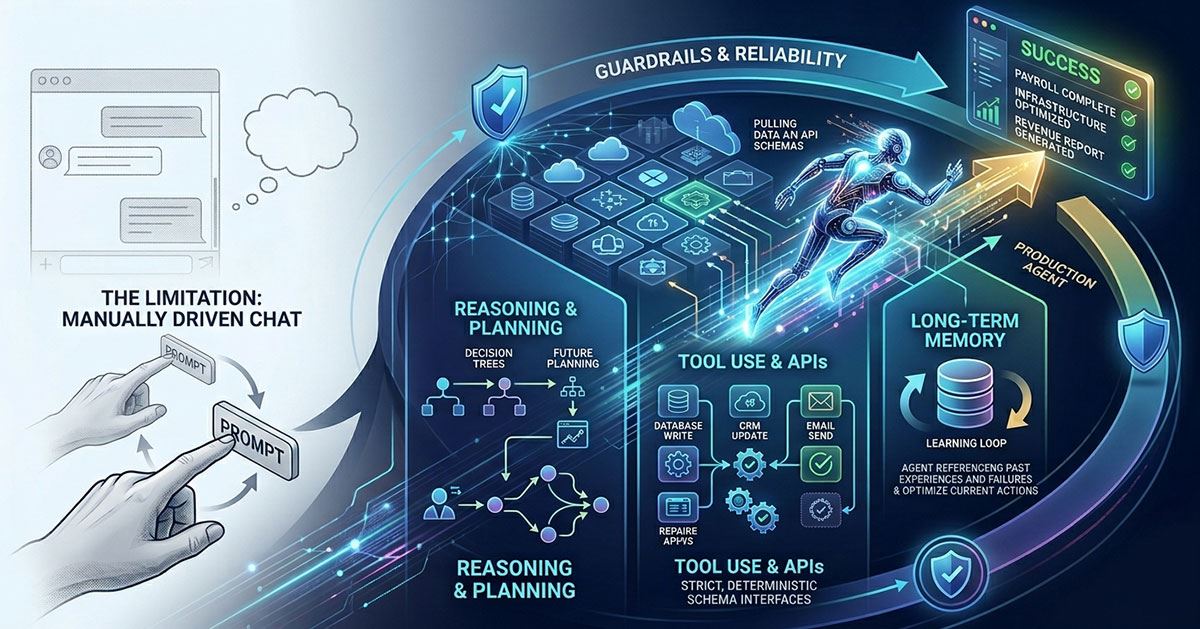
For the last few years, the world has been obsessed with the chat box. We learned how to prompt, how to iterate and how to use Large Language Models as highly sophisticated autocomplete engines. But the chat box is a limitation. It requires a human in the loop for every single step. If you want a task done, you have to tell the AI to do it, check the result, and then tell it what to do next. This is not automation. This is just a very fast conversation.
In 2026, we are seeing a fundamental pivot. The industry is moving from Generative AI to Agentic AI. The difference is simple but profound. While a chatbot answers a question, an agent achieves a goal. An agent can plan a sequence of actions, use external tools, self-correct when it hits a wall and operate autonomously over long periods. This is the Agentic Shift, and it is where the actual economic value of AI is being realized.
The Architecture of Agency
To understand why agents are finally hitting production at scale, we have to look at the architectural evolution. Early attempts at agents were often just loops of prompts that frequently hallucinated or entered infinite cycles. The current production grade systems rely on a more robust framework involving three core pillars: reasoning, tool use and memory.
Reasoning is no longer just about the next token. We are seeing the rise of advanced planning techniques where the model creates a multi step plan before executing the first action. This reduces the likelihood of the agent getting lost halfway through a complex task. When an agent can say, “First I need to fetch the client data, then I will compare it against the Q3 projections and finally I will draft the summary email,” it becomes a reliable worker rather than a random generator.
Tool use is the bridge between the digital brain and the real world. Production agents are now integrated with specific APIs through strictly defined schemas. Instead of hoping the AI knows how to use a tool, developers are providing deterministic interfaces. This ensures that when an agent decides to “Update CRM Record,” it does so using a validated function call that cannot accidentally delete the entire database.
Finally, memory is the secret sauce for scale. Short term memory handles the current task, but long term memory allows an agent to learn from previous failures. If an agent tried to access a server via a specific port and failed, a production grade system records that failure. The next time the agent encounters a similar problem, it refers to its experience and tries a different approach. This iterative learning is what makes an agent feel like an experienced employee rather than a fresh graduate.
The Reliability Gap: Moving from Demo to Production
The biggest hurdle in the transition to agents has been the reliability gap. In a demo, a 90 percent success rate looks magical. In production, a 10 percent failure rate is a catastrophe. If an agent is automating payroll or managing cloud infrastructure, a single hallucination can result in significant financial loss.
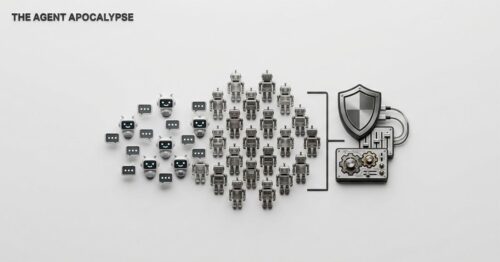
Companies are solving this not by trying to make the models perfect, but by building “guardrail” architectures. This involves creating a supervisor agent that monitors the worker agent. The supervisor does not do the work but instead validates the output of each step against a set of business rules. If the worker agent proposes an action that violates a security policy, the supervisor blocks it and demands a correction.
Another critical development is the move toward “human in the loop” by exception. Instead of a human approving every step, the system only flags high risk actions. This allows the agent to handle 95 percent of the mundane work while surfacing the 5 percent of complex edge cases to a human expert. This hybrid model is the only way to scale AI agents without sacrificing safety.
Economic Implications and the New Workflow
The economic impact of the Agentic Shift is a transition from “cost per token” to “cost per outcome.” In the chatbot era, we paid for the volume of text generated. In the agentic era, the value is in the completed task. This changes the entire pricing model of software as a service. We are moving toward a world where you do not pay for a seat in a software tool, but for the successful completion of a business process.
This shift also redefines the role of the human worker. The job is moving from execution to orchestration. The most valuable skill in 2026 is not knowing how to code or write, but knowing how to design an agentic workflow. This means understanding how to break a complex business goal into smaller, manageable tasks that an AI can execute reliably.
The Path Forward
As we look toward the rest of the decade, the integration of agents will only deepen. We are moving toward “swarms” of specialized agents that communicate with each other to solve massive problems. One agent handles research, another handles analysis, and a third handles formatting and delivery. They operate as a cohesive unit, coordinated by a central objective.
The transition is not without risk. The potential for autonomous systems to create unforeseen cascades of errors is real. However, the alternative is staying in the chat box, which is a dead end. The companies that embrace the agentic shift and invest in the boring work of reliability, monitoring and guardrails will be the ones that dominate the next era of the digital economy.