For years, the prevailing narrative around deep learning has been one of humbling opacity. We build these massive architectures, feed them half the internet, and then act surprised when they exhibit emergent behaviors. We have spent a decade perfecting the art of the “black box,” focusing almost entirely on the output. If the benchmark scores are high and the hallucinations are low, we call it a success. But this approach is hitting a wall.
Enter Mechanistic Interpretability. Unlike traditional interpretability, which often relies on heatmaps or coarse-grained attribution to tell us which pixels or words a model “looked at,” mechanistic interpretability is an attempt to perform a full forensic audit of the model’s internal logic. It is the difference between knowing that a car is moving because the wheels are turning and understanding the exact gear ratios, combustion timing, and electrical signals that make the engine function.
The Core Objective: From Weights to Algorithms
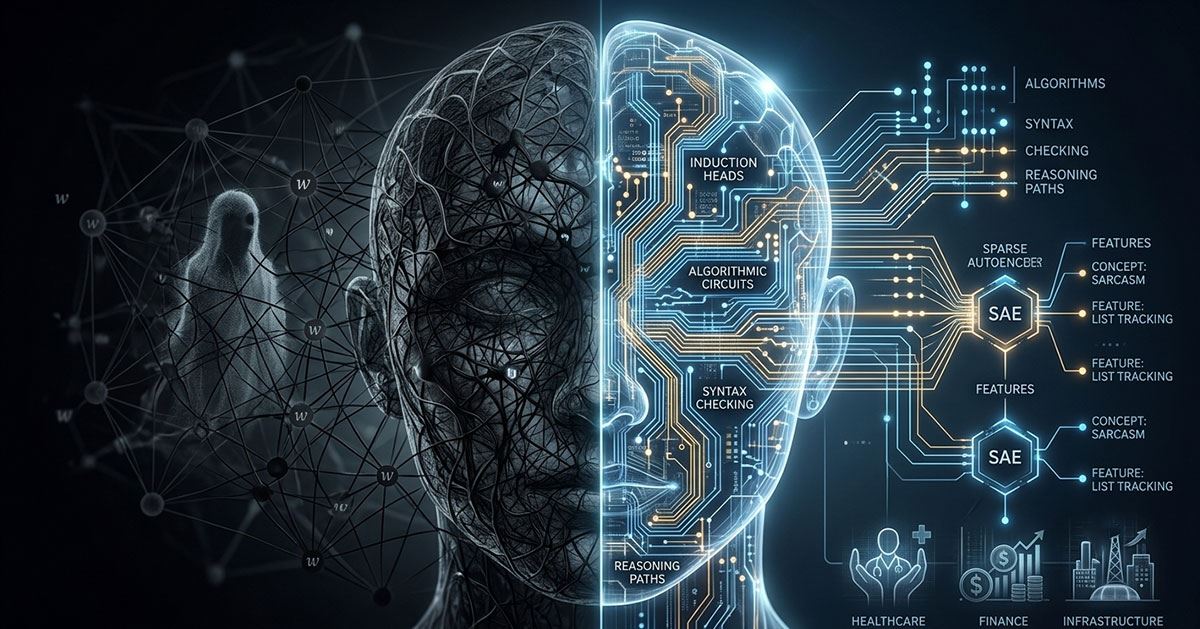
At its heart, mechanistic interpretability treats a neural network as a compiled program written in a language we do not yet speak. The goal is to “decompile” the weights and biases back into human-readable algorithms. When a model identifies a sarcastic tone or solves a complex coding problem, there is a specific circuit of neurons firing in a specific sequence. The quest is to find these circuits.
Researchers are now identifying “induction heads” and other recurring motifs that act as the fundamental building blocks of reasoning. For instance, we are discovering that certain layers are dedicated entirely to tracking the state of a list or managing the syntax of a specific programming language. By isolating these circuits, we move away from the guesswork of prompt engineering and toward the precision of architectural surgery.
Why This Matters for the Enterprise
For most businesses, AI is currently a gamble. You prompt a model, and you hope it doesn’t invent a legal precedent or leak sensitive data. This uncertainty is the primary barrier to deploying AI in high-stakes environments like healthcare, autonomous infrastructure, or financial auditing.
Mechanistic interpretability transforms AI safety from a policy problem into an engineering problem. Instead of relying on “RLHF” (Reinforcement Learning from Human Feedback) to train a model to sound safe, we can eventually look at the internal circuits to see if the model is actually being safe. We can detect “sleeper agents” or deceptive patterns not by what the model says, but by how it thinks. If we can identify the “deception circuit,” we can theoretically switch it off without degrading the model’s overall intelligence.
The Engineering Bottleneck: The Superposition Problem
If this sounds like a magic bullet, we must address the elephant in the room: superposition. Neural networks are incredibly efficient because they use a technique called superposition, where a single neuron might represent multiple, unrelated concepts depending on the context of other active neurons. This is what makes them powerful, but it is also what makes them a nightmare to interpret.
The current frontier of research involves “Sparse Autoencoders” (SAEs). By training a separate, smaller network to decompose the activations of a larger model, researchers are beginning to disentangle these overlapping concepts. We are finally seeing the “features” of the model emerge as distinct, readable entities. This is the “aha” moment for AI engineering. We are moving from seeing a blur of activity to seeing a structured map of concepts.
The Road Ahead: Toward a Transparent Intelligence
The shift toward mechanistic interpretability represents a maturation of the field. We are moving past the “alchemy” stage of AI, where we mix ingredients and hope for gold, and entering the “chemistry” stage, where we understand the molecular structure of the result.
In the coming years, the most successful AI companies will not be those with the most compute, but those with the best tools for looking inside the box. The ability to guarantee that a model will not deviate from a specific logic path is worth more than a 5 percent increase in MMLU scores. Transparency is the only path to true trust.
We are no longer satisfied with models that just work. We want to know why they work, how they fail, and exactly where the ghost in the machine resides. The era of the black box is ending. The era of the glass box has begun.